Start With How Bold Your Countertop Already Is
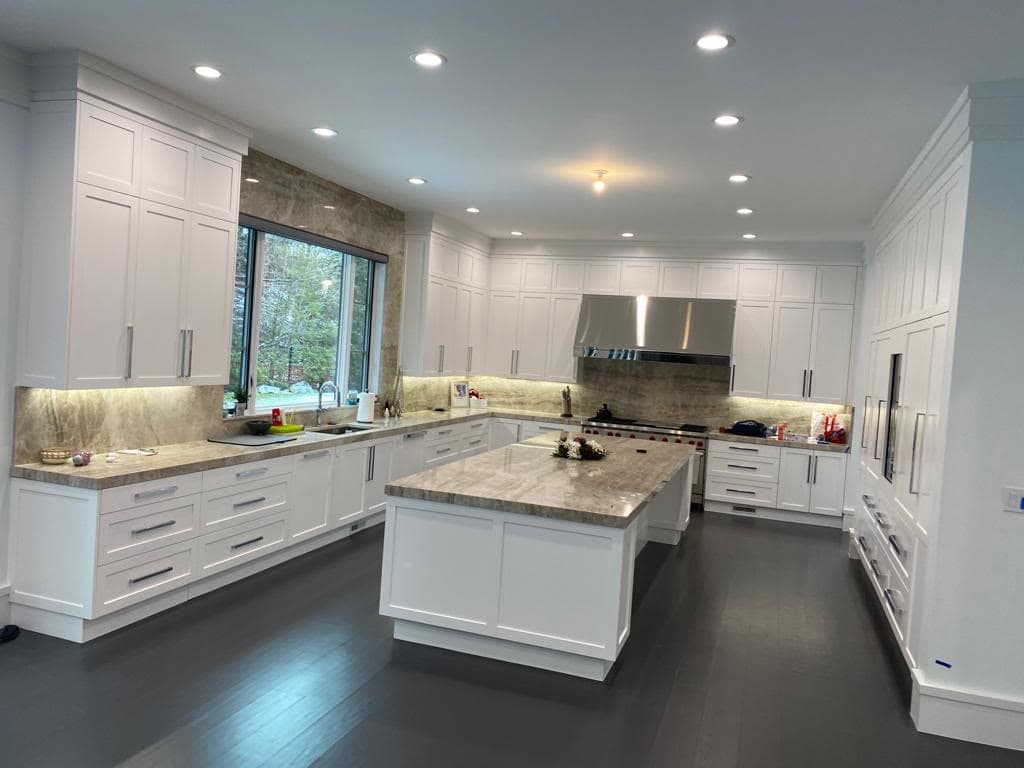
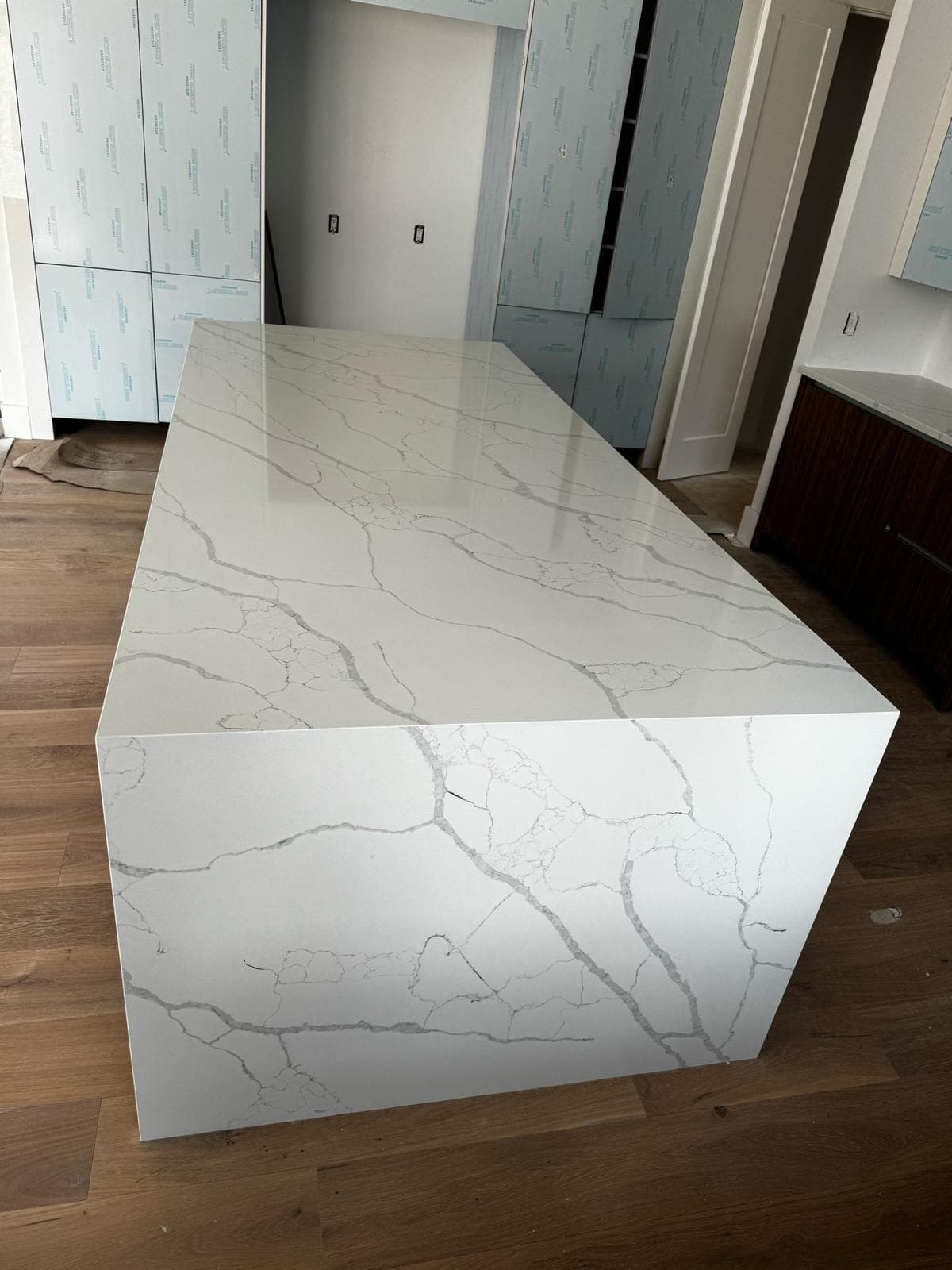
The single biggest factor in choosing a backsplash is how much movement your countertop has. Stone falls on a scale. A calm granite with a fine, even grain or a plain white quartz reads as a quiet background. A dramatic quartzite with sweeping veins or a bold-patterned marble reads as a statement.
Once you know where your counter sits on that scale, the decision gets simple. A busy stone wants a calmer backsplash so the eye has somewhere to rest. A calm stone gives you room to add pattern or a full-height slab feature without the space feeling crowded. The rule that saves most kitchens: pick one hero. Let the counter be the star or the backsplash be the star, but do not ask both to compete.
The Three Main Backsplash Options
Almost every kitchen backsplash comes down to one of three approaches. Each has a different look, cost, and feel.
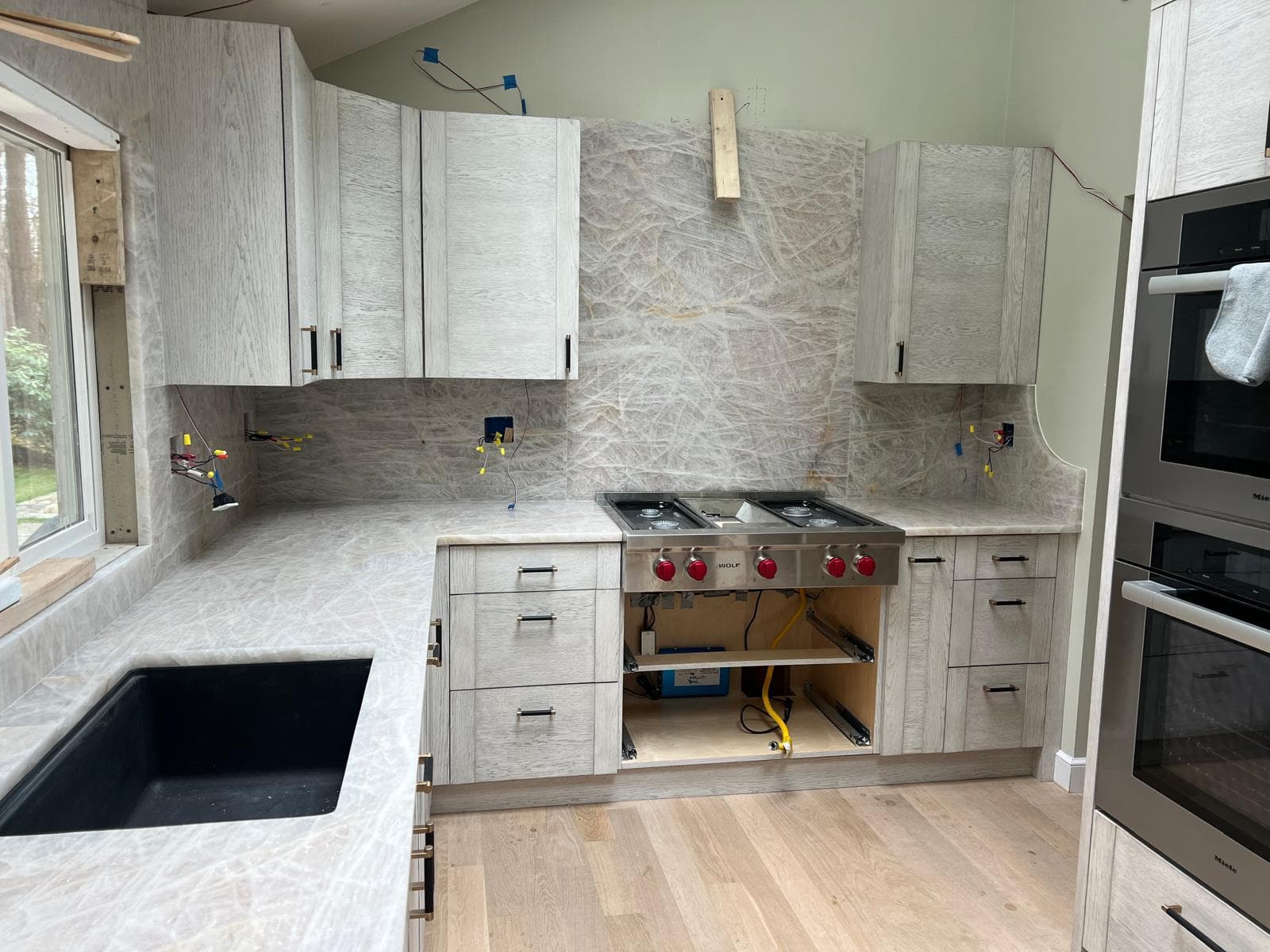
- Full-height stone backsplash: the same slab material runs from the counter up to the underside of the upper cabinets. It is seamless, easy to wipe down, and can be book-matched so the veining mirrors across the seam for a mirrored, high-end effect. This is the most premium look and the one we fabricate from the same slab as your counters.
- Short stone backsplash: a 4-inch strip of the same stone runs along the back of the counter. It is the most budget-friendly, hides the wall-to-counter gap, and lets you add paint or tile above it.
- Tile paired with stone counters: subway, zellige, mosaic, or large-format tile above a short stone ledge or straight off the counter. Tile brings color, texture, and pattern that stone alone cannot.
How to Match or Contrast Color and Veining
If you want a cohesive, calm look, match. A full-height run of the same slab is the ultimate match because it is literally the same stone. With tile, pull a color that already appears in your countertop, often one of the softer background tones or a vein color, and carry it up the wall. This ties the two surfaces together without looking flat.
If you want contrast, choose a backsplash that is clearly different in tone but shares an undertone. A warm cream counter pairs well with a warm terracotta or tan tile, not a cold gray one. Contrast in value works well too: a light backsplash behind a dark counter, or a dark backsplash behind a light counter, adds depth. What to avoid is a near-match that is slightly off, where a tile is almost the counter color but not quite. That reads as a mistake rather than a choice.
Busy Stone Versus Busy Tile: Do Not Fight
This is the most common misstep we see. When a countertop has heavy veining or a strong pattern, a patterned or high-contrast tile behind it creates visual noise. The two surfaces fight, and the kitchen feels cluttered even when everything is new and clean.
The fix is straightforward. Bold counter, simple backsplash: a solid or subtly textured tile, or a full-height slab of the same stone so the veining flows as one piece. Simple counter, bold backsplash: a plain quartz or fine-grain granite gives you the freedom to use a colorful zellige, a graphic mosaic, or a strong geometric tile. Let one surface carry the drama.
Grout, Maintenance, and the Cost Trade-Offs
Backsplashes are not just a look decision. They are a cleaning decision too. Tile has grout lines, and behind a stove those lines catch grease and can stain or discolor over time, especially with a lighter grout. A full-height stone backsplash has no grout across the field, just a single seam or two, so it wipes clean like the countertop itself. That is a real advantage right behind the cooktop.
On cost, the three options usually land in this order from lowest to highest: a short 4-inch stone ledge, then tile over a ledge, then a full-height slab. Countertop material installed tends to run in the range of roughly $40 to $140 per square foot depending on the stone, and a full-height backsplash adds slab square footage, so it is the larger investment. Many homeowners split the difference: a full-height slab behind the range as a focal point, with tile or a short ledge along the rest of the run. Your exact numbers depend on the stone you choose and your layout, which is what an in-home estimate is for.
Design Tips That Work in Real Kitchens
A few small choices make a backsplash feel intentional rather than accidental. Carry the counter and backsplash decision together, not weeks apart, so the pieces are chosen as a set. Bring a physical sample of your stone when you look at tile, since screens and showroom lighting distort color. And think about your lighting: under-cabinet lights wash directly down a backsplash and exaggerate texture and grout, so a busy tile can look busier at night than it did in the store.
For the highest-end result with the least maintenance, a book-matched full-height stone backsplash behind the range is hard to beat. It turns the wall into a feature and keeps cleanup simple. If you are weighing your options, the fastest way to decide is to see the materials in your own kitchen with your own light. We offer free in-home estimates across Massachusetts and New England, and our full-height stone backsplashes are fabricated in-house from the same slab as your counters so the match is exact. Call (774) 823-0961 to set one up.