What Is a Waterfall Island Countertop?
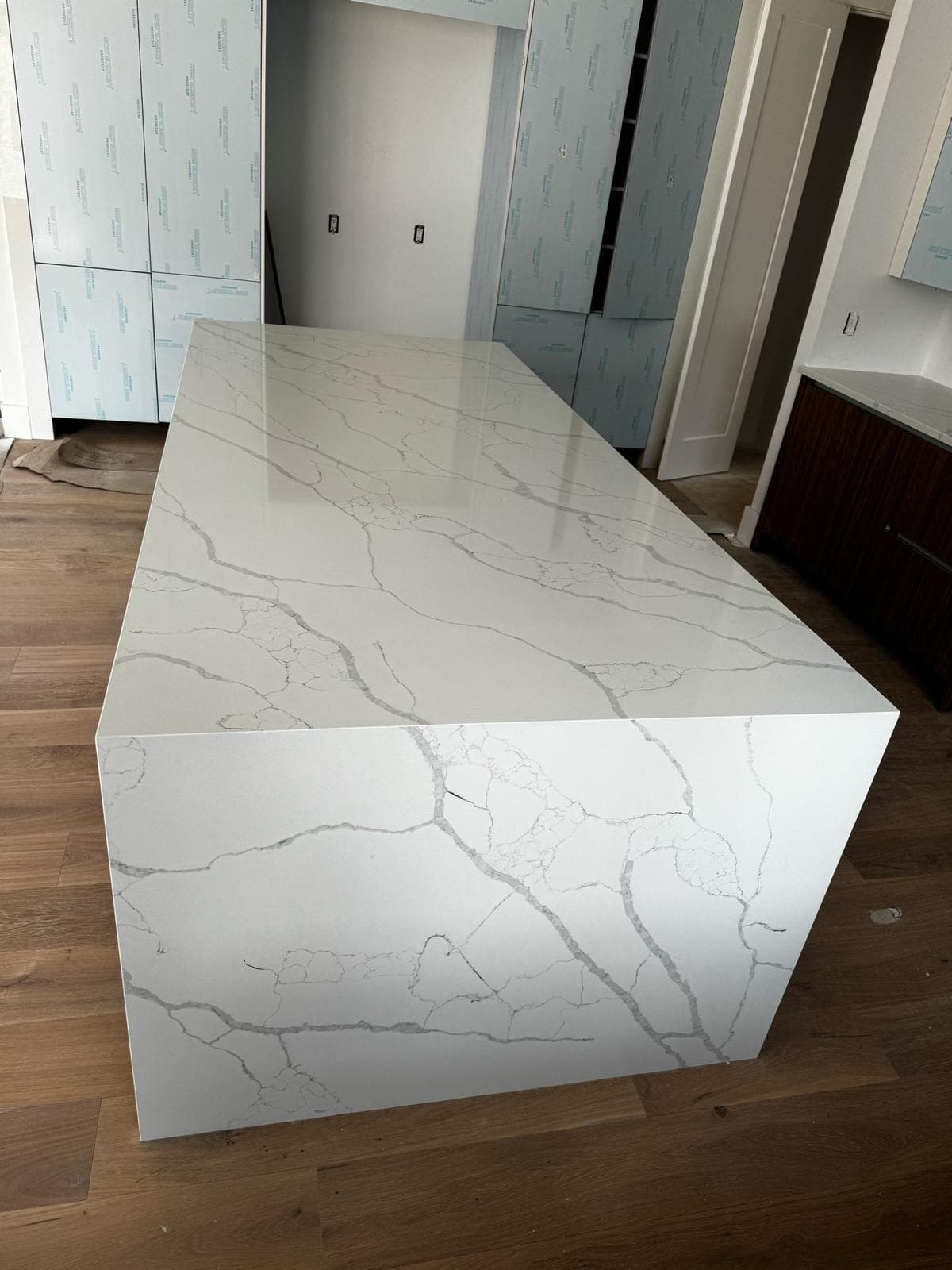
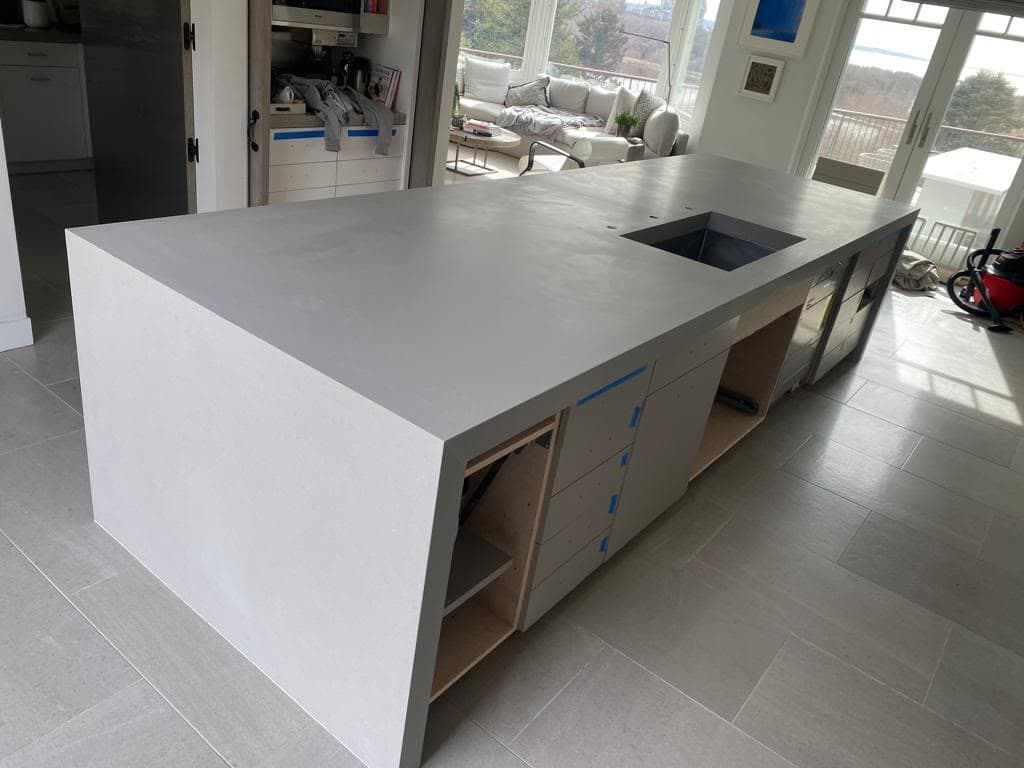
A waterfall island is a countertop where the stone does not stop at the edge of the counter. Instead, it turns 90 degrees and runs straight down the side of the island to the floor, so the surface looks like it is pouring over the end like a sheet of water. You get a continuous slab of stone on the top and down one or both ends.
Compared to a standard island, where the counter has a finished edge and the cabinet sides are exposed, a waterfall wraps the stone all the way to the floor. It is a modern, high-end look that shows off the material, which is why it is popular on kitchen islands, but it also works on bar tops, fireplace surrounds, and desks.
The visual payoff depends heavily on the stone and the fabrication. A waterfall done well looks like one solid block of granite or quartz. Done poorly, the seam at the corner gives the whole thing away.
The Mitered Edge: Why Fabrication Skill Matters
The magic of a waterfall is the corner where the top meets the vertical drop. To make it look like one continuous piece, fabricators cut each slab at a 45-degree angle and join the two 45s to form a tight 90-degree corner. This is called a mitered edge, and it is the difference between a waterfall that looks custom and one that looks like two pieces stuck together.
At Havenstone, mitered waterfall edges are standard work in our in-house shop. A clean miter takes precise cutting, careful glue-up, and hand polishing so the joint nearly disappears. If the angle is off by even a little, or the polish does not match across the seam, you see a line at the corner.
The harder part is vein matching. On stones with movement, like marble or quartzite, the veins on the top need to continue down the vertical face as if the stone were folded over the edge. That means laying out the slab, planning the cut around the pattern, and sometimes book-matching two pieces so the veins mirror each other. This is skilled layout work, not a machine setting, and it is a big reason waterfall islands cost more.
Best Materials for a Waterfall Island
Almost any slab material can be turned into a waterfall, but some make the look far more striking than others.
Quartzite is a favorite for waterfalls. It is a natural stone with dramatic veining and it is very hard and durable, so it stands up to a vertical panel that people brush past. The bold movement makes the continuous flow over the edge really show.
Quartz (engineered stone) is the practical pick. It is consistent, non-porous, and comes in patterns that run predictably, which makes vein continuity across the miter easier to plan. If you want a clean, low-maintenance waterfall, quartz is hard to beat.
Marble delivers the most luxurious result, especially with book-matching, where two slabs are opened like a book so the veins mirror across the island. It is stunning, but marble is softer and etches from acids, so it asks for more care. Granite and soapstone also work well and each brings its own character.
- Quartzite: bold natural veining, very durable, premium look
- Quartz: consistent pattern, low maintenance, easiest to match
- Marble: most luxurious, great for book-matching, needs more care
- Granite and soapstone: durable, characterful, budget-friendly options
What a Waterfall Island Costs
Installed countertops in our range run roughly $40 to $140 per square foot depending on the stone, and a waterfall adds cost on top of the flat surface for two main reasons.
First, more stone. Each waterfall side is essentially a second countertop hanging vertically, so a single waterfall panel can add several square feet, and a double waterfall doubles that. On a large island, the extra material is significant, especially with a premium quartzite or marble.
Second, miter labor. Cutting, joining, and polishing the mitered corner is detailed handwork, and vein matching adds layout time before a single cut is made. Because pricing swings so much with slab choice, island size, single versus double, and how much veining needs matching, the honest answer is that a waterfall is best quoted from your actual layout. That is exactly what a free in-home estimate is for.
Single vs Double, and Design Styles
A single waterfall drops the stone down one end of the island. It gives you the effect at a lower cost and is a good choice when one side is the visible focal point of the kitchen. A double waterfall runs the stone down both ends for a fully symmetrical, furniture-like block. It costs more but reads as a true showpiece.
Style comes down to the stone and the edge. A thick, chunky waterfall in dark soapstone or a heavily veined quartzite feels bold and architectural. A crisp white quartz with a fine gray vein reads clean and modern. Book-matched marble with mirrored veins feels custom and luxurious.
You can also play with slab thickness and how the waterfall meets the floor. Many designs run the stone all the way down for a grounded, solid look, which pairs well with a full-slab backsplash elsewhere in the kitchen for a coordinated feel.
Pros, Cons, and Resale Value
The upside is real. A waterfall island is a genuine centerpiece, it protects the cabinet sides from scuffs and kicks, and it signals a high-end kitchen the moment someone walks in. If you love the look and plan to enjoy the kitchen, it is a satisfying upgrade.
The honest downsides: it costs meaningfully more than a standard island, the extra stone panels can catch bumps from stools and feet, and softer stones like marble need more care on that exposed vertical face. It is also a strong design statement, so it commits you to a modern look.
On resale, treat it as a feature that helps sell the kitchen rather than a guaranteed dollar-for-dollar payback. A well-executed waterfall in a durable stone makes a kitchen photograph and show beautifully, which matters to buyers, but returns depend on your home, your market, and how well the work is done. Our take: if you want it for yourself and it fits the budget, it is worth it. If you are only chasing resale, put the money into a great slab and clean fabrication first.
The best way to decide is to see the slabs in person and get real numbers. Come look at quartzite, quartz, and marble options, and we will bring a free in-home estimate to your actual island. Call Havenstone at (774) 823-0961.